Question and mechanism
Higher gasoline prices can increase the value of job access in a car-oriented city. The paper asks whether registered property-price gradients by fixed pre-reform access changed around Kuwait's national fuel-price increase.
Design
Neighborhood exposure is predicted access to the 2011 workplace distribution, fixed before the reform. The analysis traces pre-slope, first-full-quarter break, and post-slope changes for recorded-land and completed-home transfers. It reports transaction weights, equal neighborhood-quarter weights, common geography, rolling pseudo-breaks, alternative access definitions, and leave-one-neighborhood-out estimates.
The outcome is log nominal registered transfer price per recorded plot square metre among observed sales. For completed homes, the numerator includes the house and plot and the denominator is plot area, not floor area. "Recorded land" is an administrative source category, not verified vacant land.
What the paper finds
Source: Kuwait Ministry of Justice; author's calculations.
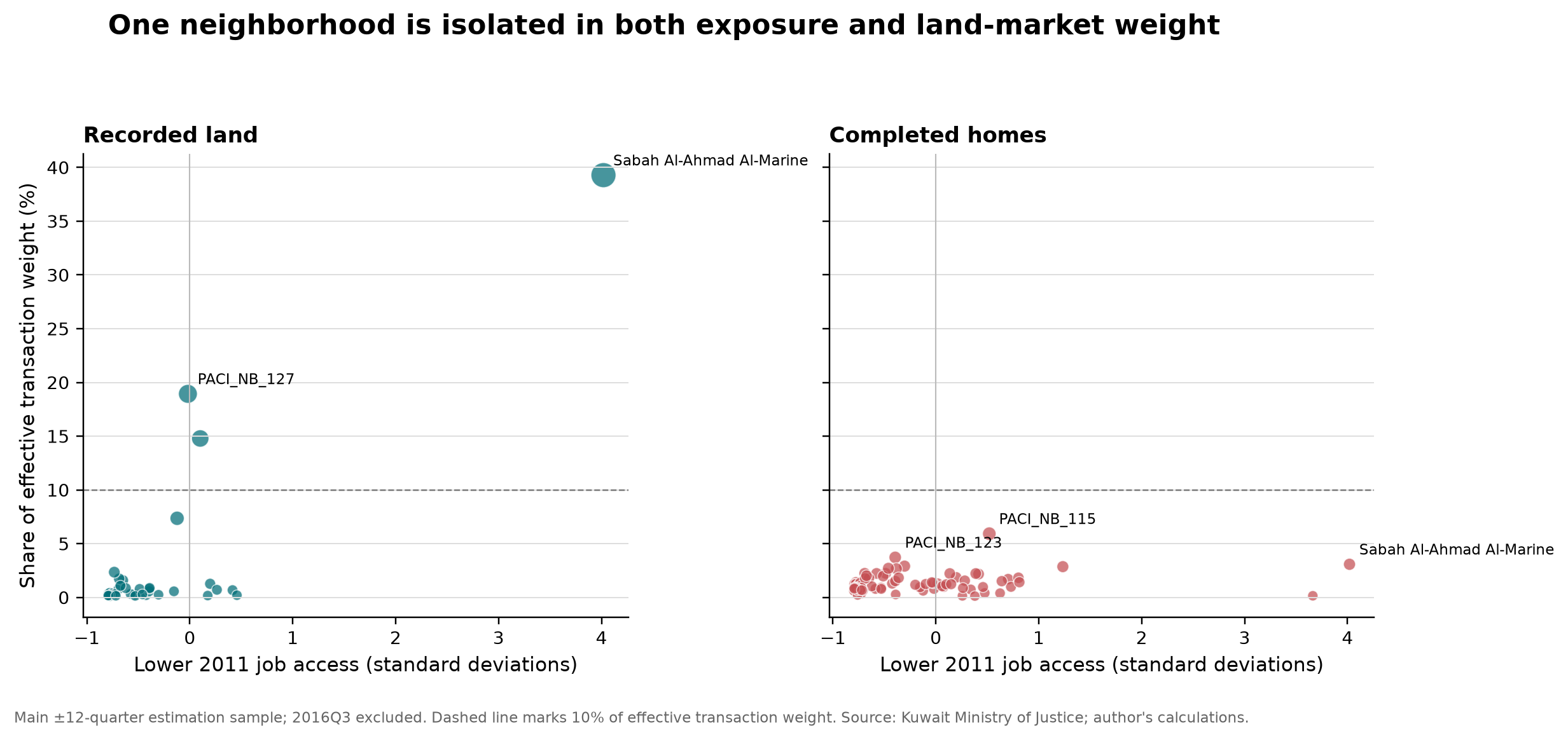
The baseline gradient was already moving before the reform. Dropping Sabah Al-Ahmad Al-Marine flips every land parameter, and equal neighborhood-quarter weighting makes the land path nearly flat. The policy-centered local break is also not distinctive relative to nearby dependent pseudo-break dates.
What the paper does and does not claim
The study documents a spatial transaction cycle organized around a meaningful reform date and fixed access measure. It does not identify a causal reform effect, a property-stock price response, realized commuting behavior, household welfare, or a stable structural difference between administrative land and completed-home categories.
The next empirical step is to explain the development history, plot releases, infrastructure delivery, and sale incidence of Sabah Al-Ahmad Al-Marine in a balanced neighborhood-quarter panel that includes zero-sale cells.
Citation and data source
Suggested citation: Mallooki. 2026. "A Fuel Reform During a Moving Land-Price Gradient: Job Access and Registered Property Transactions in Kuwait." Working paper.
Transaction source: Kuwait Ministry of Justice, Live Registered Real-Estate Sale-Price Query. All reported estimates are the author's calculations from registered transactions. The public PDF contains aggregate estimates and no transaction rows, deed identifiers, or exact transaction locations.