A national flow panel, not refinery accounts
The panel covers January 2019 through May 2026, with the main charts ending in December 2025. Each record combines a month, one of nine product codes, and one of three flows: refinery output, exports, or domestic demand.
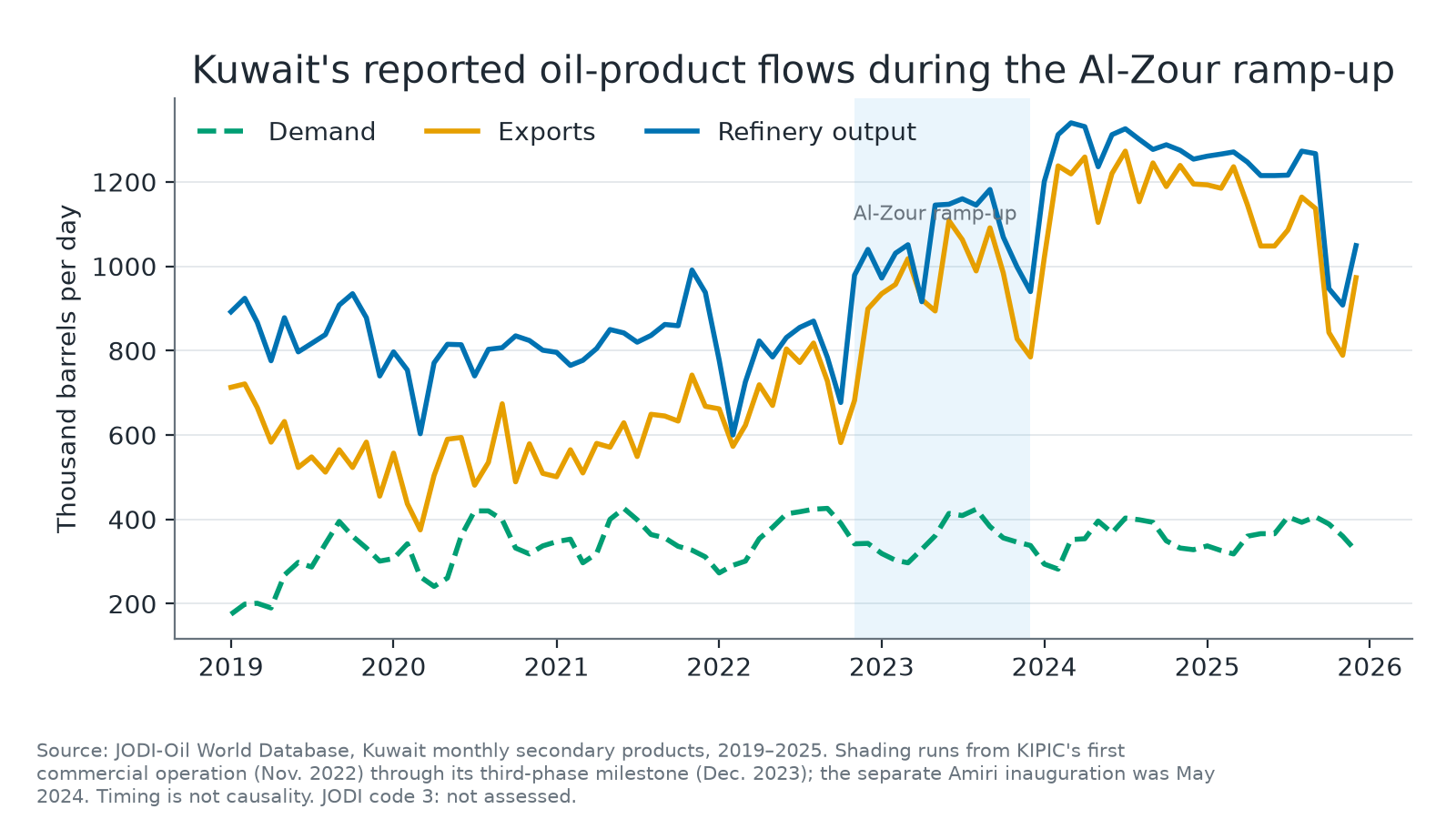
Al-Zour supplies the chronology. It does not supply identifying variation. KIPIC records first commercial operation in November 2022 and later operating phases through December 2023. The data do not report refinery-level throughput or shipments.
The component hierarchy reconciles exactly to JODI's total-products series. Kerosene-type jet fuel remains an "of which" subcomponent of kerosene and is not counted twice.
Exports rose faster than output or demand
View full-size figure (opens in a new tab)
The exports-to-output ratio compares two annual national flow means. It is not the share of the same contemporaneous output barrels that were exported. Imports, inventories, blending, transfers, and timing can separate those quantities.
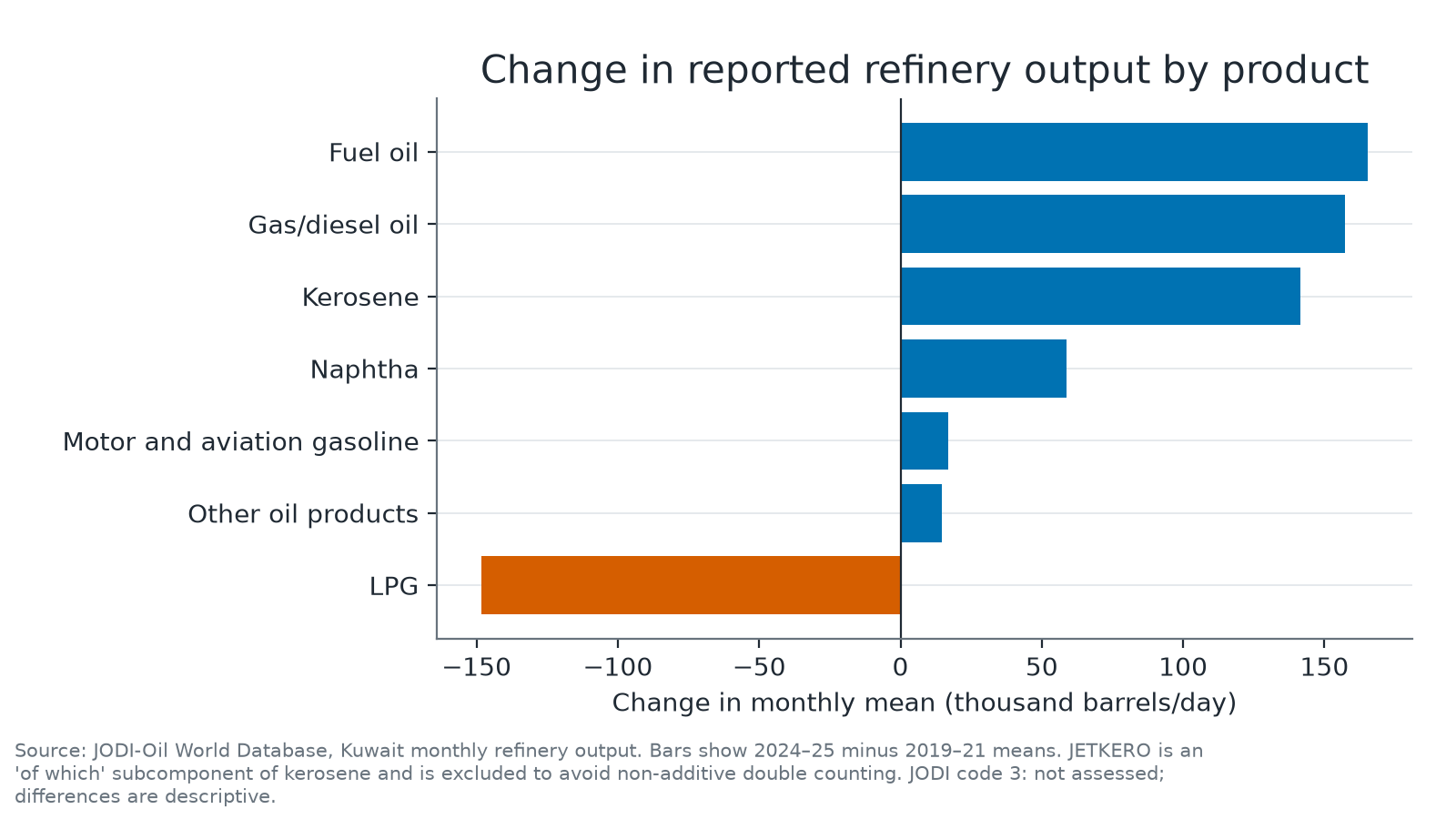
The output change was concentrated in a few products
View full-size figure (opens in a new tab)
The largest positive differences were about 165 thousand barrels per day for fuel oil, 157 thousand for gas and diesel oil, and 141 thousand for kerosene. LPG moved in the opposite direction, lower by about 148 thousand barrels per day.
The mix is consistent with a broader change in Kuwait's conversion capacity and exportable output. It cannot separate Al-Zour from maintenance, commissioning at other facilities, inventories, sanctions, global margins, or the Clean Fuels Project.
What the charts do and do not establish
The charts establish that Kuwait's reported downstream system became larger and more export-oriented on these national measures. They do not estimate Al-Zour's causal effect, refinery utilization, product margins, export destinations, or value added. Internal reconciliation checks the transformation, but it cannot validate Kuwait's original submissions to JODI.
Citation and sources
Suggested citation: Abdulmalik Altararwa. 2026. "Kuwait's Downstream Shift, in Two Public-Data Charts." Research blog.
Sources: The flow panel uses the JODI-Oil World Database. The operating chronology comes from KIPIC reporting. The US Energy Information Administration documented the broad shift in 2023.
Public-release boundary: This page publishes aggregate estimates, original figures, and source links. It does not publish raw records, restricted data, or local research files.