Six import baskets from public records
The six Harmonized System chapters are meat, dairy and eggs, vegetables, pharmaceuticals, machinery, and electrical equipment. The data contain broad chapters and recorded partner areas, not products, firms, invoices, or shipments.
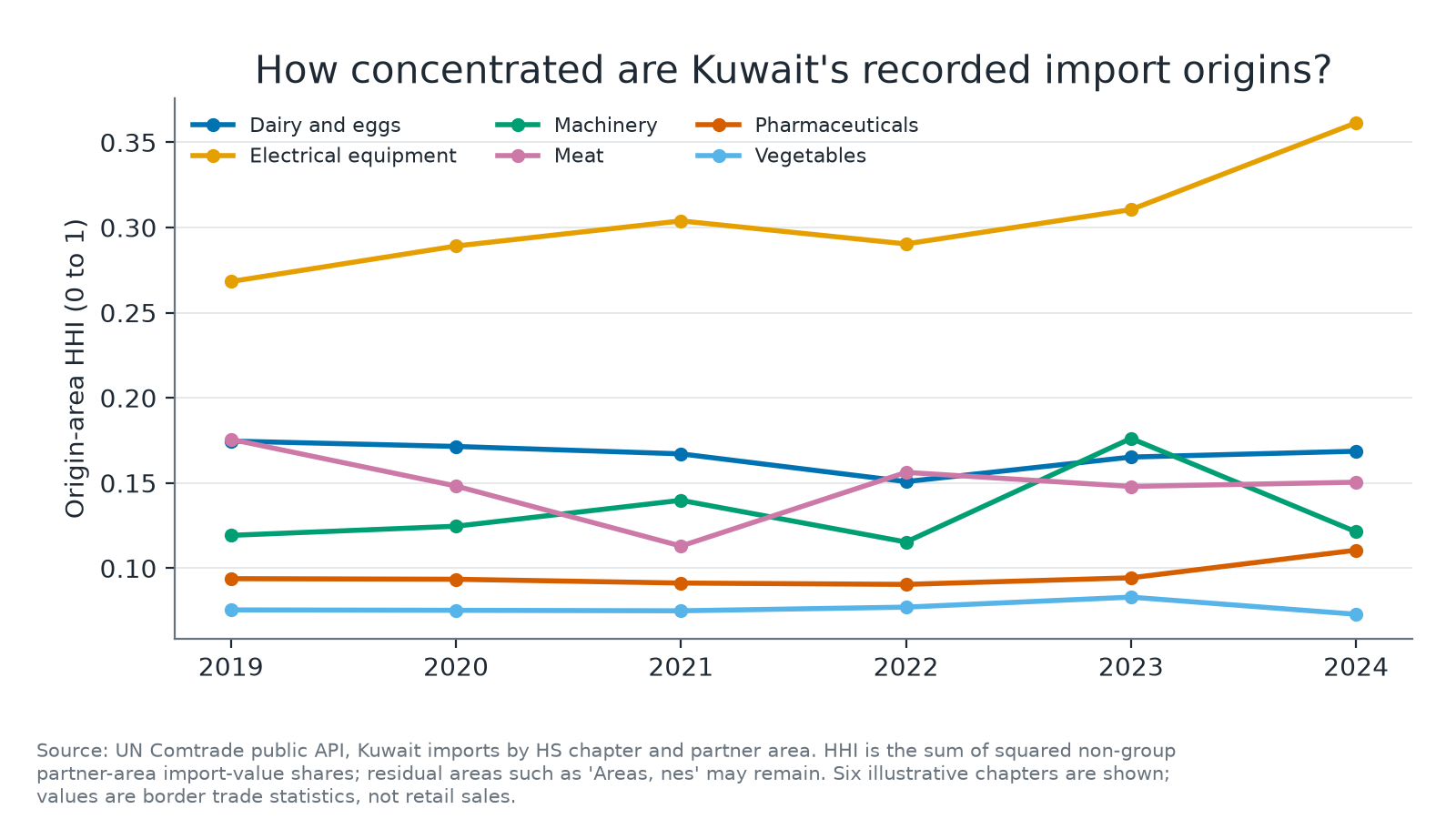
For each chapter and year, I calculate a Herfindahl-Hirschman Index from import-value shares across non-group origin areas. The index rises when more recorded value comes from fewer origins. It is a concentration measure for the sourcing structure, not a price index or a ranking of social vulnerability.
Electrical equipment stands apart
View full-size figure (opens in a new tab)
Electrical equipment's HHI rose from 0.268 in 2019 to 0.361 in 2024. The 2024 values were 0.169 for dairy and eggs, 0.150 for meat, 0.121 for machinery, 0.111 for pharmaceuticals, and 0.073 for vegetables.
A diversified basket can still depend on a common route or upstream input, while a concentrated basket can rest on reliable long-term suppliers. The graph identifies different sourcing structures. It does not finish a supply-risk assessment.
A fixed-share origin-currency index
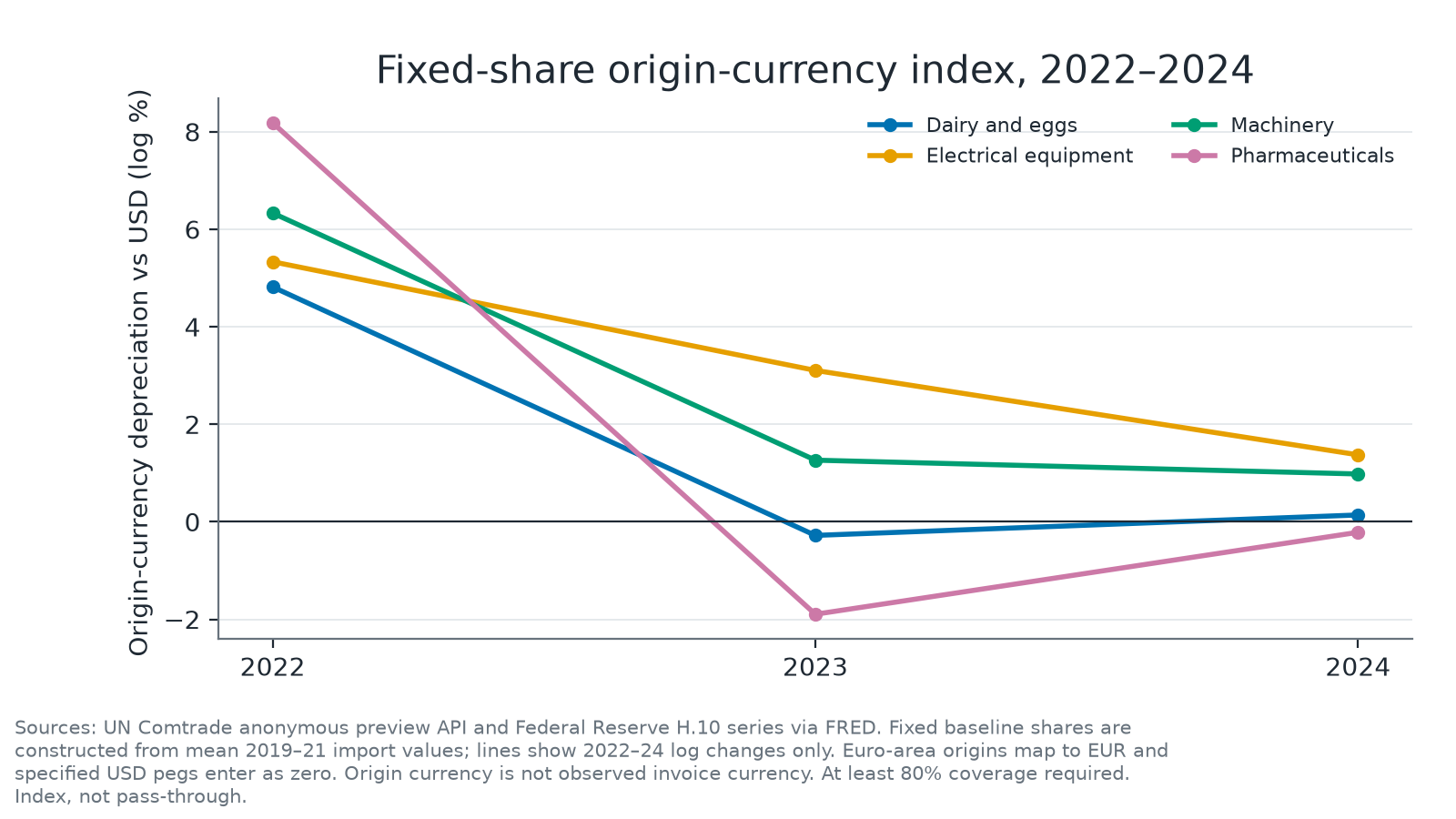
I freeze each chapter's origin weights at mean 2019 to 2021 import values. Covered origins are mapped to public exchange-rate series, and annual currency movements are combined with those fixed weights. Only baskets with at least 80% covered baseline value appear in the chart.
View full-size figure (opens in a new tab)
All four displayed baskets load onto broad dollar appreciation in 2022, but by different amounts. The covered-share-normalized movements range from 4.8 log percent for dairy and eggs to 8.2 for pharmaceuticals. The cross-basket spread is widest in 2023.
What the measures do and do not establish
The figures establish that Kuwait's import exposures differ across product chapters. They do not measure imported inflation, supplier price shocks, invoice-currency exposure, or exchange-rate pass-through. Those questions require usable product quantities and prices, actual invoice currency, and a design that separates external shocks from changing demand and sourcing.
Citation and sources
Suggested citation: Abdulmalik Altararwa. 2026. "Kuwait Does Not Have One Import Exposure." Research blog.
Sources: Trade values come from the UN Comtrade public API. Currency series come from Federal Reserve H.10 releases through FRED.
Public-release boundary: This page publishes aggregate estimates, original figures, and source links. It does not publish raw records, restricted data, or local research files.