Authorization, cash, and delivery are different objects
An enacted capital allocation authorizes spending at the start of the fiscal year. A closing account records cash expenditure after the year ends. An administrative follow-up reports where a list of development projects sits in a delivery process. An engineering audit would ask whether physical work was completed to specification.
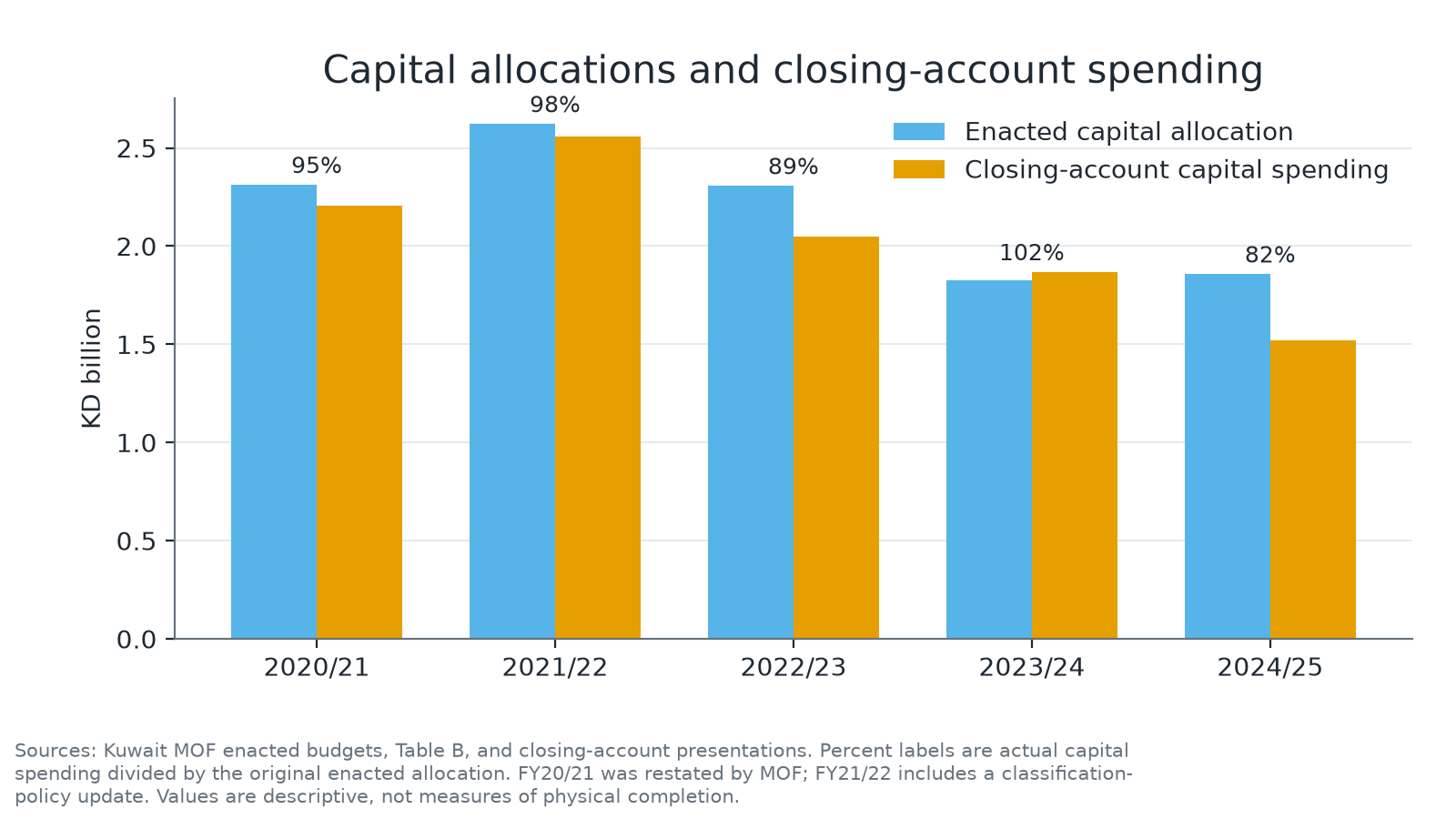
These objects can move together, but they are not interchangeable. The clean comparison begins by naming the numerator, denominator, date, and project universe for each rate.
A denominator-specific cash-execution series
View full-size figure (opens in a new tab)
The 102.3% value says recorded capital cash spending slightly exceeded the original enacted allocation. It does not show overspending against the final amended appropriation because that denominator is not in the public series used here.
Project stages answer another question
View full-size figure (opens in a new tab)
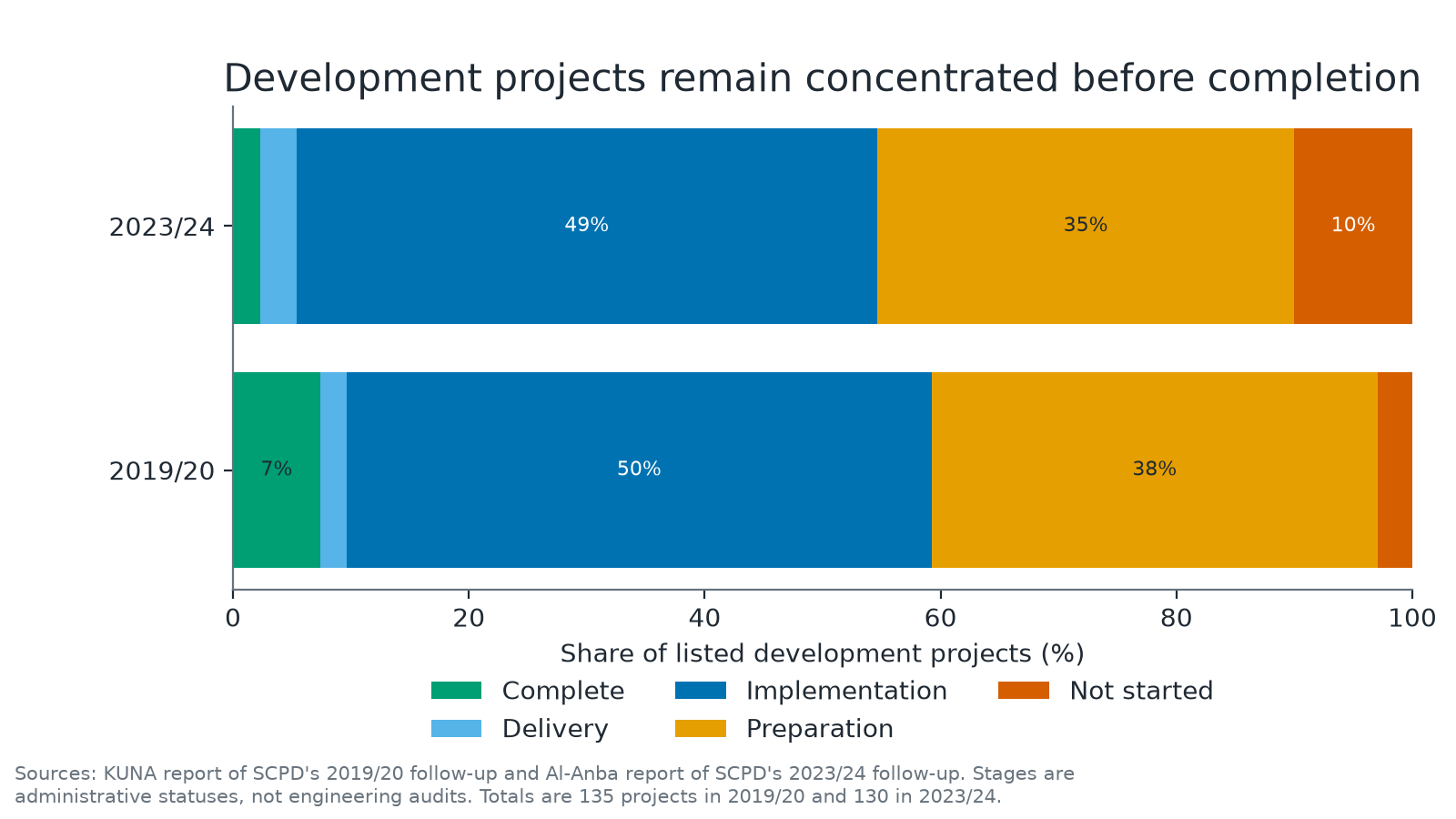
The FY2019/20 public snapshot recorded 10 completed projects among 135. The FY2023/24 snapshot recorded 3 among 130, while roughly half of each list was in implementation. For FY2023/24, the reported development-project envelope spent KWD 450.8 million of KWD 1,022.222 million, or 44.1%.
The 44.1% project-envelope rate is not inconsistent with the 102.3% chapter-level cash rate. Their universes differ.
What the records do and do not establish
The series clarifies fiscal accounting and public administrative records. It does not reveal final amended chapter 32 appropriations, stable project cohorts, procurement delays, contractors, physical milestones, quality, or causal effects. Readers should not use cash execution as a synonym for engineering completion.
Citation and sources
Suggested citation: Abdulmalik Altararwa. 2026. "How Kuwait Can Have a 102.3% and a 44.1% Execution Rate in the Same Year." Research blog.
Sources: Fiscal values come from the Kuwait Ministry of Finance enacted budgets and closing accounts. Plan-stage snapshots come from attributed SCPD reporting.
Public-release boundary: This page publishes aggregate estimates, original figures, and source links. It does not publish raw records, restricted data, or local research files.