Research blog / Kuwait public economics / August 2026

Kuwaitization's Denominator Problem

Why a rising national share can hide a falling Kuwaiti headcount

At a glance

Question
What happened to registered Kuwaiti private-sector headcount and share after 2019, and why can those measures move in opposite directions?
Main finding
The Kuwaiti share rose from 4.27% in 2019 to 4.96% in 2022 even though Kuwaiti headcount fell by 1,516, because non-Kuwaiti headcount contracted much faster.
Evidence limit
Aggregate snapshots do not measure firm compliance, enforcement, worker transitions, or the causal effect of Kuwaitization rules. Current 2026 requirements cannot be back-cast to 2019.

The national Kuwaitization share is a ratio. It can rise because Kuwaiti employment grows, because non-Kuwaiti employment falls, or because both move at different rates. Kuwait's registered private-sector series shows the second mechanism from 2019 to 2022: the Kuwaiti share rose while Kuwaiti headcount slipped. Activity-specific requirements also vary widely, so the national share cannot establish whether an individual firm complied.

Worker series
Annual 30 June snapshots, 2015 to 2022
Kuwaiti headcount
73,837 in 2019; 72,321 in 2022
Kuwaiti share
4.27% in 2019; 4.96% in 2022
Current requirements
13 activities observed in August 2026

What the public series measures

The CSB series records registered private-sector workers at 30 June each year. It excludes domestic workers and does not follow individuals between jobs, sectors, or legal statuses. The chart therefore compares annual stocks rather than hires, exits, or worker transitions.

A national nationality share is Kuwaiti headcount divided by total registered private-sector headcount. Reading the share without both components can reverse the story.

The post-2019 rise came from the denominator
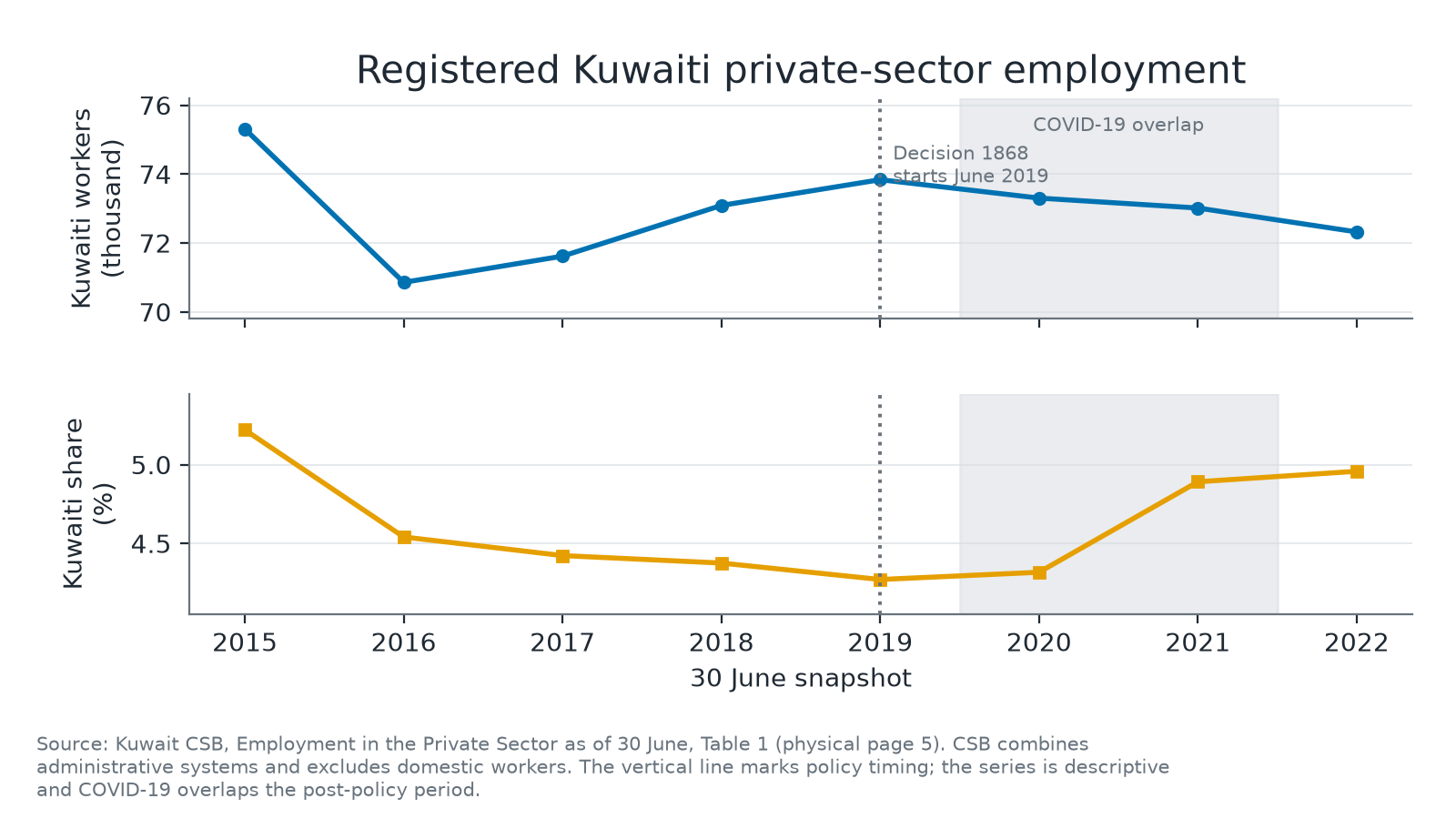
Two line panels showing registered Kuwaiti private-sector headcount and share from 2015 through 2022.
Registered Kuwaiti private-sector employment and share at annual 30 June snapshots. The line after 2019 is descriptive and overlaps the COVID-19 period. Source: Kuwait Central Statistical Bureau; author's calculations.

View full-size figure (opens in a new tab)

Kuwaiti headcount-2.1%73,837 in 2019 to 72,321 in 2022
Non-Kuwaiti headcount-16.2%1,655,123 in 2019 to 1,386,395 in 2022
Total employment-15.6%Registered private-sector stock
Kuwaiti share+0.69 pp4.27% in 2019 to 4.96% in 2022

The share rose because non-Kuwaiti registration contracted much faster than Kuwaiti registration. Neither the share nor the headcount is wrong. They answer different questions.

Kuwaitization is not one quota
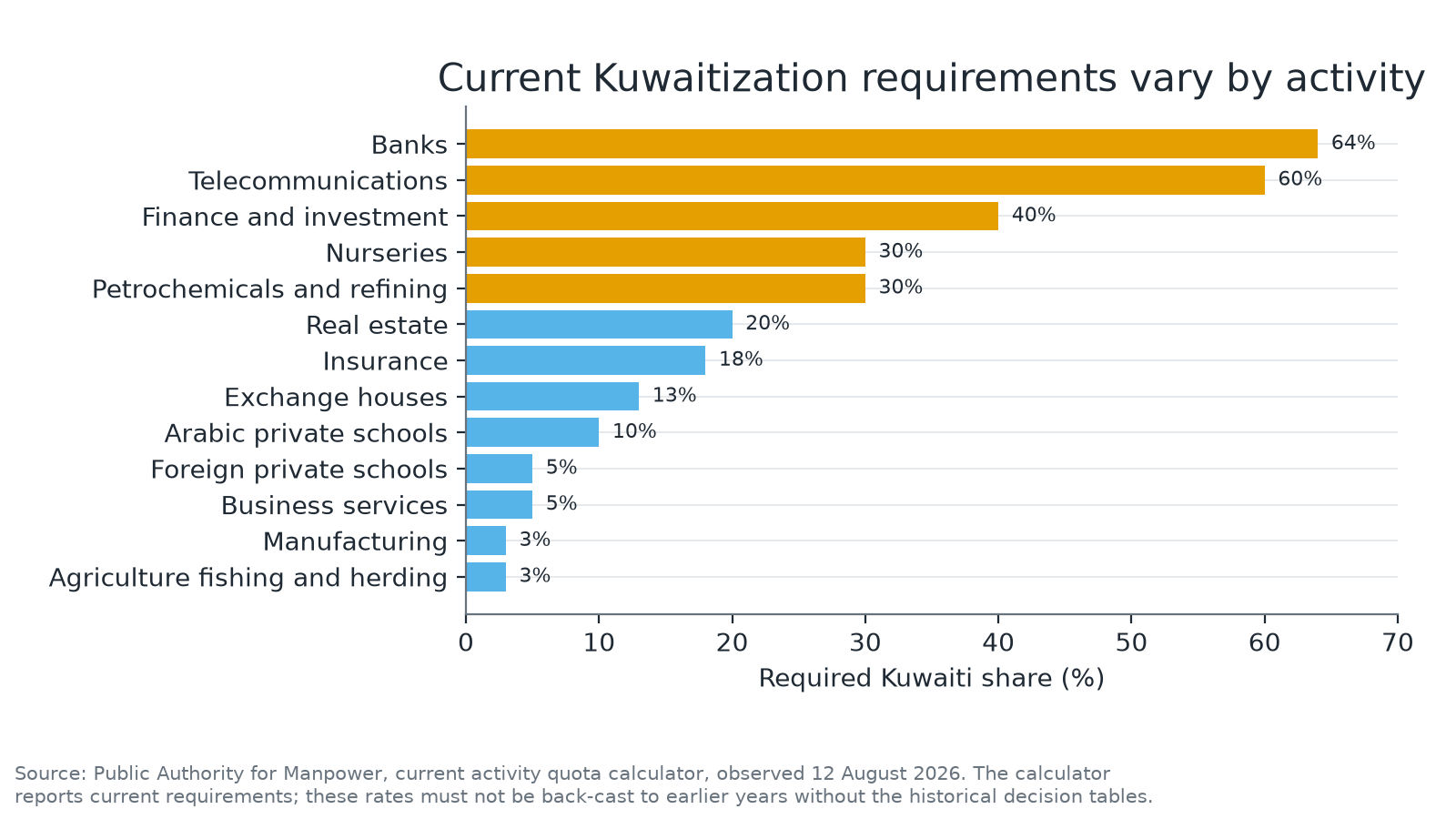
Horizontal bars of current Kuwaitization requirements across 13 activities as observed in August 2026.
Current activity-specific Kuwaitization requirements range from 3% to 64%. These 2026 rules must not be treated as the historical 2019 schedule. Source: Kuwait Public Authority for Manpower.

View full-size figure (opens in a new tab)

The 13 listed activities range from 3% in manufacturing and in agriculture, fishing, and herding to 64% in banking. Telecommunications is 60%, and finance and investment is 40%. The median is 18%.

An economy-wide share cannot establish firm compliance when legal requirements differ by activity and may vary by date, firm category, and enforcement status.

What the series does and does not establish

The public data establish the arithmetic behind the national share and document current activity-specific requirements. They do not identify firm-level compliance, threshold bunching, enforcement, genuine hiring rather than registration, or policy effects. The June 2019 policy marker is chronology, not a causal treatment line.

Citation and sources

Suggested citation: Abdulmalik Altararwa. 2026. "Kuwaitization's Denominator Problem." Research blog.

Sources: Worker counts come from Kuwait Central Statistical Bureau private-sector employment bulletins. Current requirements come from the Public Authority for Manpower calculator.

Public-release boundary: This page publishes aggregate estimates, original figures, and source links. It does not publish raw records, restricted data, or local research files.