Start with the survey population
The target population covers formal private establishments with at least 1% private ownership and five or more workers in covered manufacturing and service industries. It excludes informal firms, self-employed workers, and micro establishments with fewer than five workers.
The realized sample contains 150 establishments: 56 in manufacturing and 94 in services. The official API reports weighted estimates, standard errors, and unweighted analysis N. The 38.6% overall response rate means nonresponse remains a live limitation even when survey weights are used.
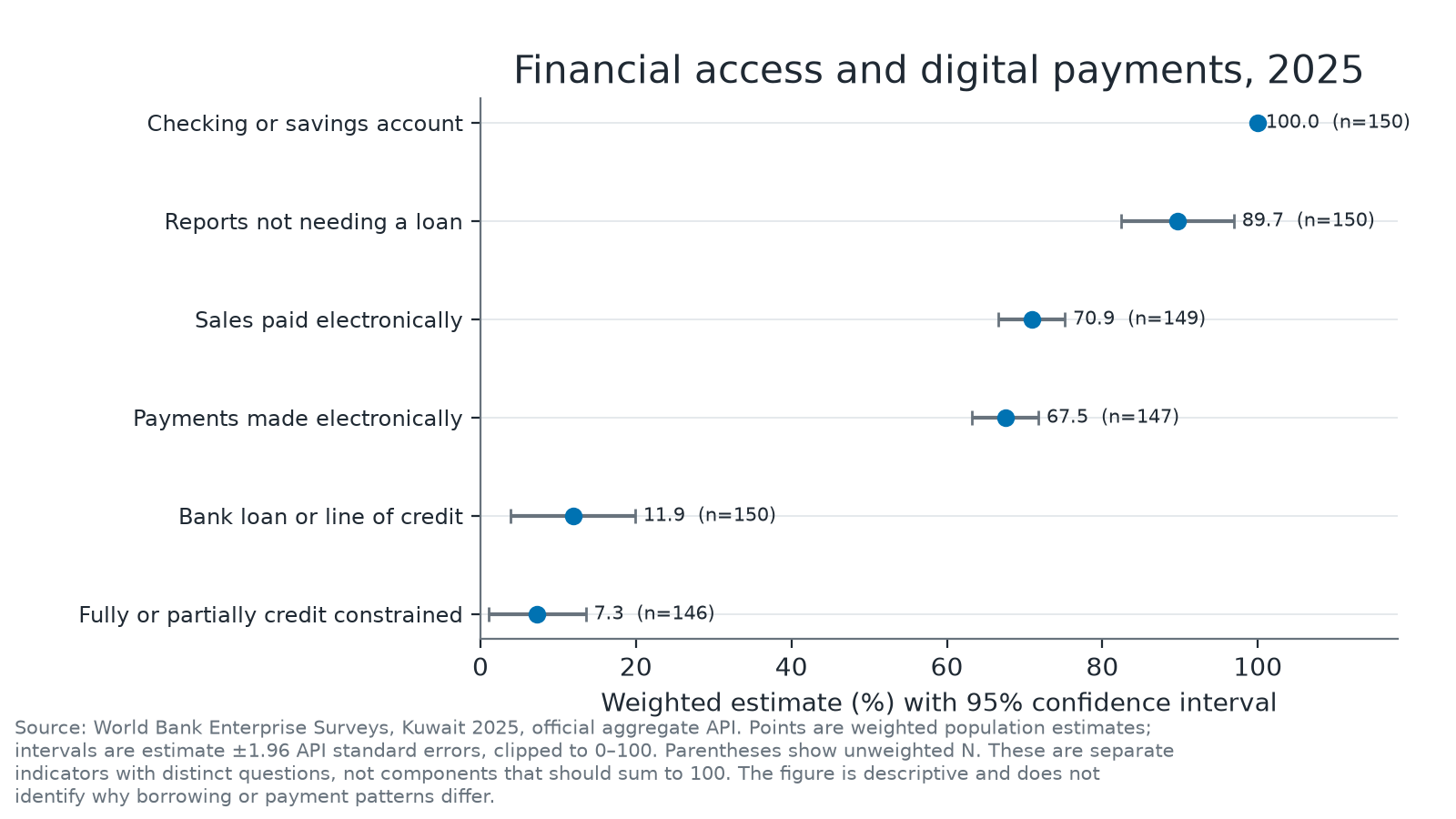
Low borrowing sits beside low measured unmet demand
View full-size figure (opens in a new tab)
The results do not prove that finance is easy. "No need" could reflect internal cash, little planned investment, debt preferences, discouragement before applying, or measurement. The aggregate endpoint cannot separate those mechanisms.
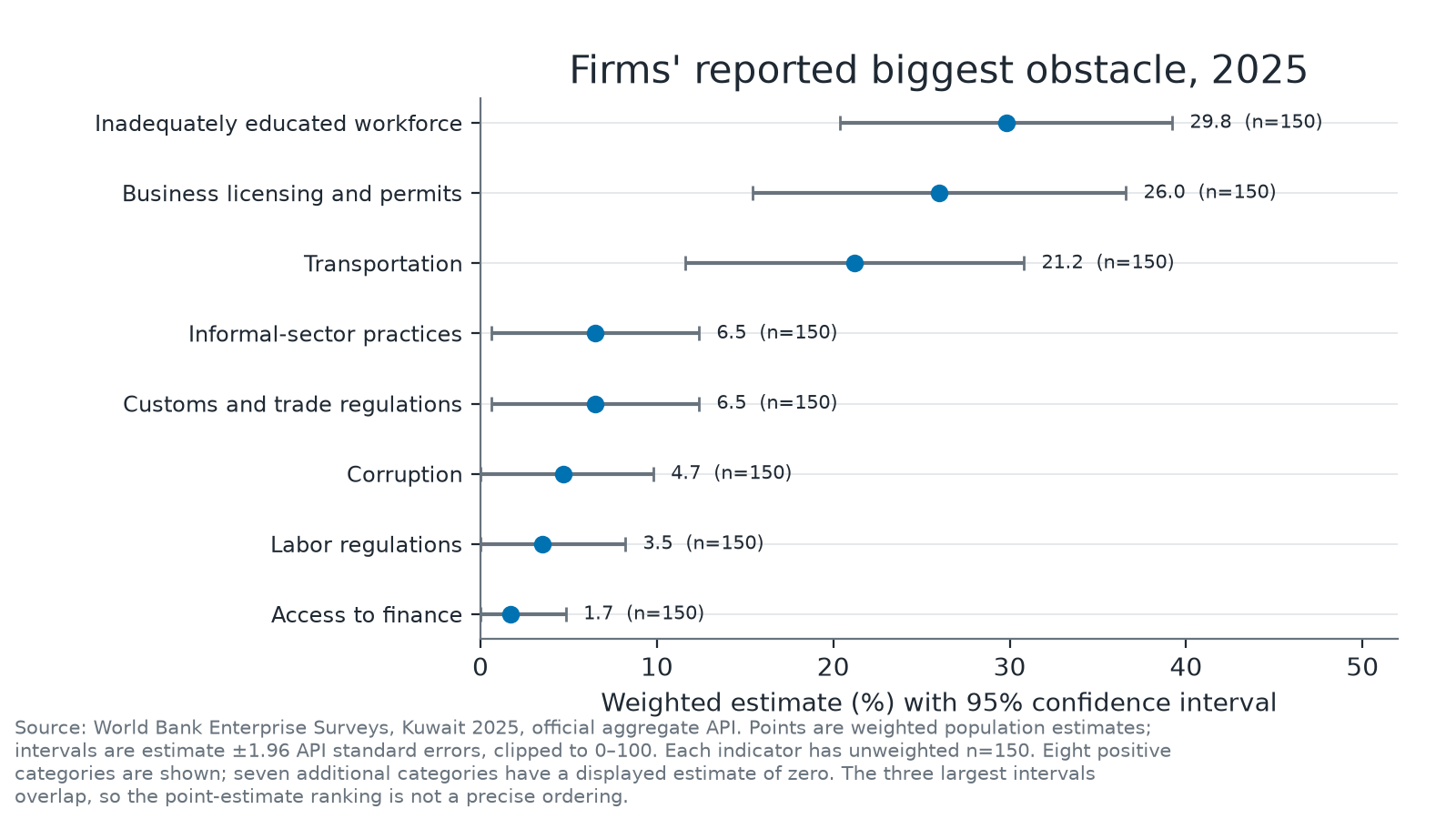
Obstacle rankings are less precise than the point estimates look
Electronic transactions are common on two separate intensity measures: the average share of sales paid electronically is 70.9%, and the average share of payments made electronically is 67.5%. These are average transaction shares, not percentages of firms and not measures of investment credit.
View full-size figure (opens in a new tab)
An inadequately educated workforce has a 29.8% point estimate, business licensing and permits 26.0%, and transportation 21.2%. Their 95% intervals overlap substantially. The data support a leading cluster, not a precise ranking of Kuwait's first, second, and third business problems.
What the survey does and does not establish
The public aggregate results establish a baseline for eligible formal establishments. They do not represent every Kuwaiti business, reveal within-firm relationships, independently reconstruct survey-design variance, eliminate nonresponse bias, or identify causal effects. A perceived obstacle is also a salience response, not a measured return to policy reform.
Citation and sources
Suggested citation: Abdulmalik Altararwa. 2026. "Kuwaiti Firms Borrow Little, but Most Say They Do Not Need a Loan." Research blog.
Sources: Estimates and population definitions come from the World Bank Enterprise Surveys Kuwait 2025 profile and public aggregate API.
Public-release boundary: This page publishes aggregate estimates, original figures, and source links. It does not publish raw records, restricted data, or local research files.