Regulatory explainer / Provisional / Kuwait public economics / August 2026

Kuwait's 2026 Platform Rulebook

How Decision 109/2026 governs both sides of the delivery market

At a glance

Question
How does Ministerial Decision 109/2026 regulate the merchant, consumer, and platform sides of Kuwait's delivery market?
Main finding
The coded rule combines merchant-charge and delivery-fee caps with provisions on multi-homing, ranking, data access, payouts, complaints, and enforcement.
Evidence limit
The article-level coding uses a secondary-hosted scan and transcript. Public evidence shows obligations on paper, not compliance, prices, entry, service quality, or welfare.

Ministerial Decision 109/2026 regulates Kuwait's intermediary platforms on both sides of the market. The coded text sets merchant-charge ceilings of 17% when the platform provides delivery and 10% when the merchant delivers. It also caps the consumer delivery fee at KWD 1. The rule reaches beyond price into multi-homing, retaliation, data access, payouts, ranking, complaints, and regulator powers. This explainer is provisional because article-level coding relies on a secondary-hosted copy while official sources confirm the instrument and Gazette issue.

Instrument
Ministerial Decision 109/2026
Coded provisions
22
Official Gazette
Issue 1799, 12 July 2026
Evidence current
12 August 2026

One rulebook for a two-sided market

Delivery platforms coordinate merchants and consumers while controlling ranking, checkout, payment, and often delivery. A rule that changes only one side can shift costs or conduct elsewhere. Decision 109 therefore combines price ceilings with rules for access, information, execution, and enforcement.
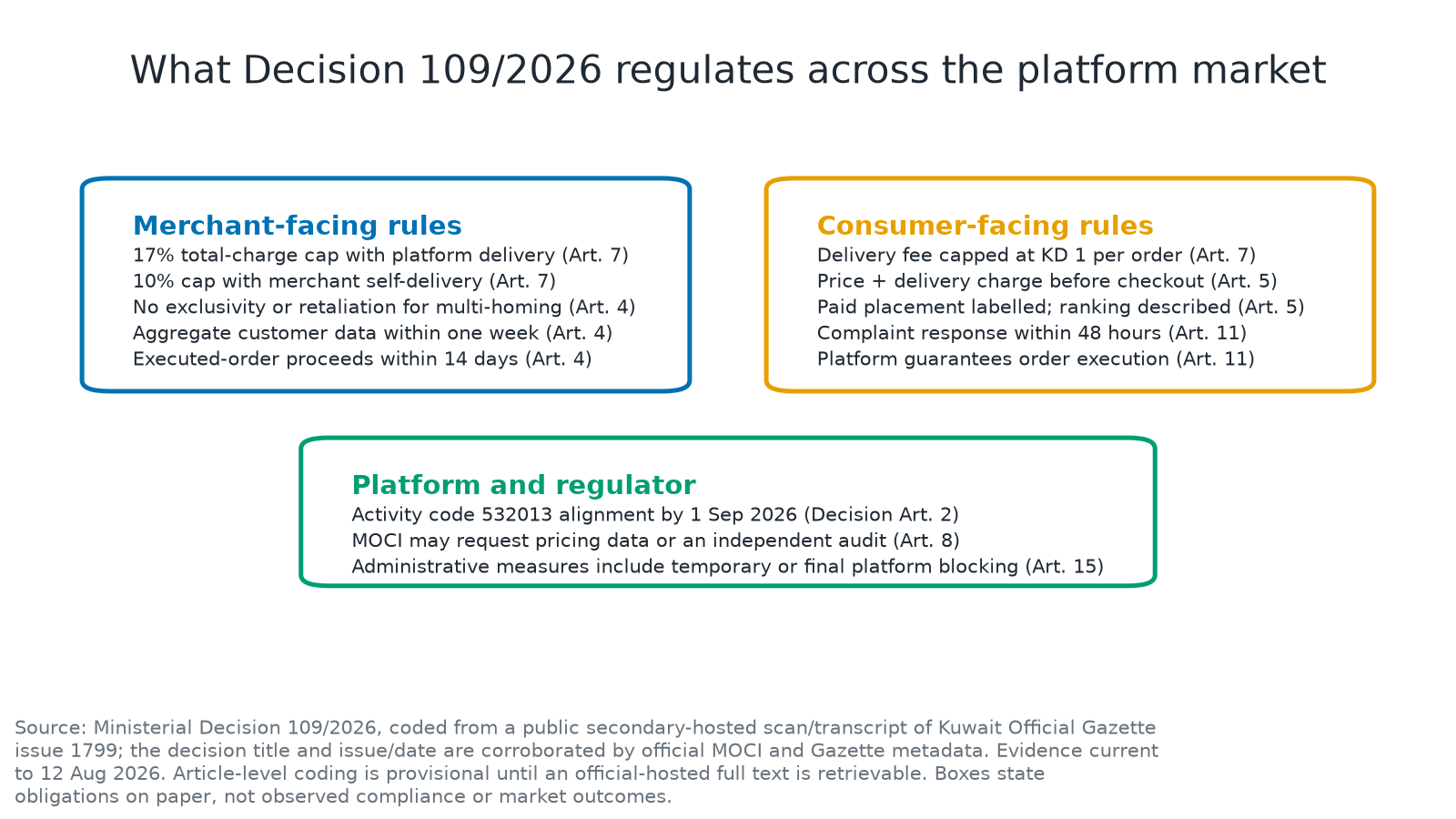
Three-part diagram of merchant-facing, consumer-facing, and regulator-facing provisions in Kuwait's Decision 109/2026.
Coded provisions across the platform market. The diagram describes obligations on paper, not observed compliance. Source: provisional coding of Ministerial Decision 109/2026, with official instrument metadata from MOCI and the Gazette.

View full-size figure (opens in a new tab)

The price ceilings are only one part of the instrument

Platform delivers17%Ceiling on total merchant charges as coded
Merchant delivers10%Ceiling on total merchant charges as coded
Consumer delivery feeKWD 1Per-order ceiling as coded
Coded provisions22Merchant, consumer, and regulator mechanisms

Merchant-facing provisions also address exclusivity, retaliation, data access, payout timing, bundling, and discriminatory ranking. Consumer-facing provisions cover pre-checkout disclosure, paid-placement labels, refunds, complaints, and responsibility for order execution. MOCI can request pricing and commission data and, when appropriate, an independent audit.

The 2026 regulatory sequence
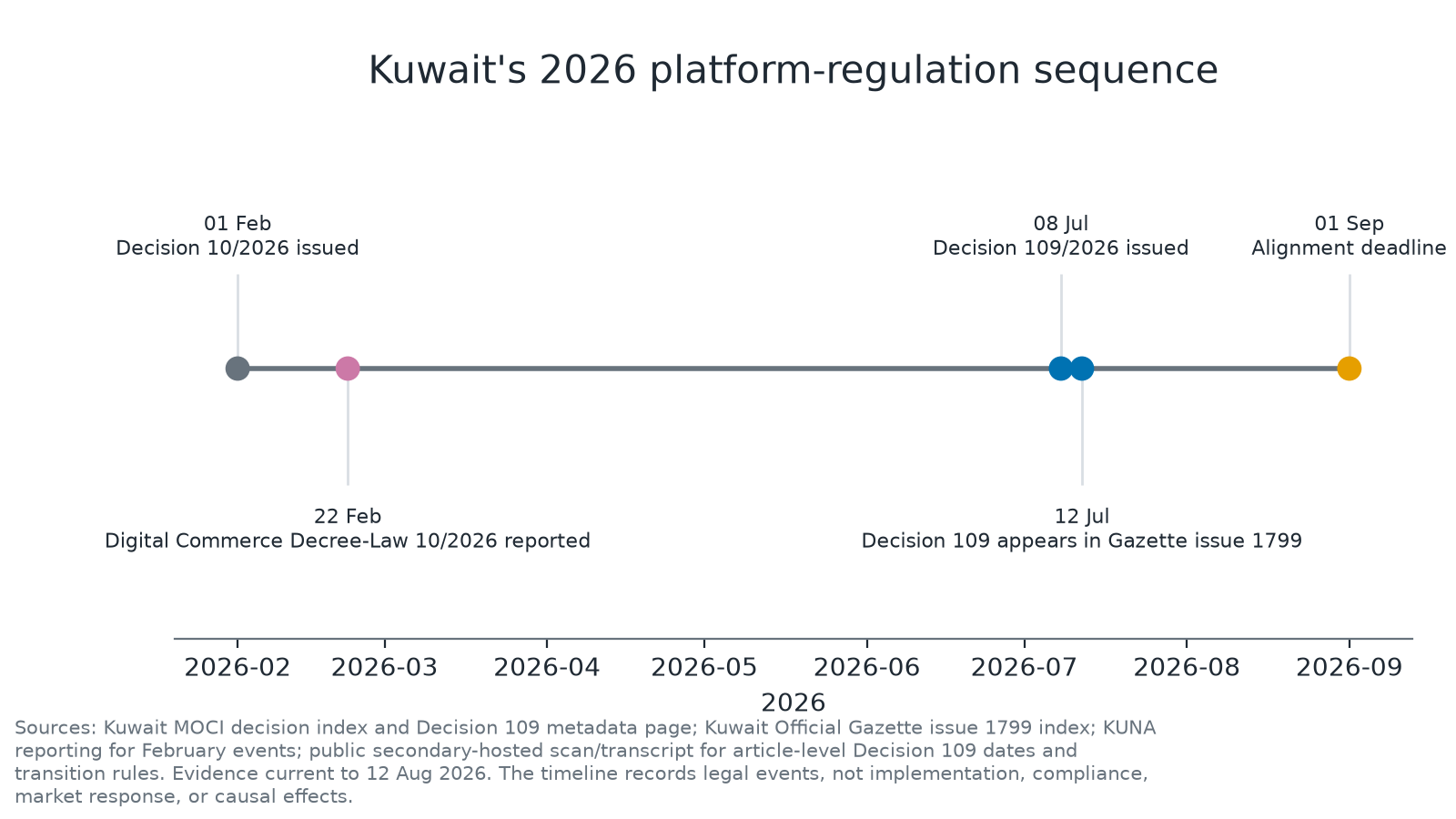
Timeline of Kuwait platform-regulation events from February through September 2026.
The 2026 regulatory sequence, including Decision 109 and the stated alignment deadline. This is a legal timeline, not an event study or evidence of implementation. Sources: MOCI, Kuwait Official Gazette, KUNA reporting, and the provisional decision text.

View full-size figure (opens in a new tab)

Official MOCI metadata confirms the instrument, and the Gazette index confirms issue 1799 on 12 July 2026. The coded text records an alignment deadline of 1 September. These dates establish the legal sequence. They do not show when platforms or merchants changed behavior.

What the explainer does and does not establish

The explainer maps the rulebook's mechanisms. It does not measure actual commissions, pass-through, checkout prices, merchant exit, platform entry, service quality, ranking, rider pay, complaints, or welfare.

The source tier is also part of the claim boundary. Official sources confirm the title and Gazette issue, while the 22 provision-level entries rely on a secondary-hosted scan and transcript. They should be rechecked if an official-hosted full text becomes directly retrievable.

Citation and sources

Suggested citation: Abdulmalik Altararwa. 2026. "Kuwait's 2026 Platform Rulebook." Regulatory explainer, provisional.

Sources: Instrument-level metadata comes from the Kuwait Ministry of Commerce and Industry and Kuwait Official Gazette issue 1799. Article-level coding relies on a public secondary-hosted scan and transcript and remains provisional.

Public-release boundary: This page publishes aggregate estimates, original figures, and source links. It does not publish raw records, restricted data, or local research files.